The treadmill you’re already on
Most work trades hours for dollars at a rate someone else decided. You stop working, the income stops the same minute. Tomorrow’s hour will pay what today’s hour paid. None of the hours stack on top of each other. None of them turn into anything you own. There’s a 401(k) compounding for the version of you that’s sixty-five, but the income itself? Not compounding.
That’s the trap. Linear effort, linear pay, nothing accumulates. It works fine when it works. It breaks the second you stop, get sick, get older, or get told your hour is now worth a dollar less.
There is a different shape of work
There’s a kind of work where the first hour you put in is still earning you money a year later.
It looks like this: you build something. Software, specifically, because software is the only product that costs nothing to copy. You put it somewhere people can pay for it. The first month it earns a little. The sixth month it earns whether you worked on it that week or not. The hours stop being a transaction and start being a deposit.
This is not passive income, and you should distrust anyone who sells it that way. There is real work: building it, finding the first customers, listening to what they actually want, fixing what’s broken. But it’s the kind of work where Tuesday’s effort is still paying you in November.
You need three things: a real problem you’ve seen up close, a narrow first version, and the willingness to listen when actual users tell you what’s wrong. That’s the whole game.
Why this didn’t exist for you five years ago
Five years ago, to build software you needed to be an engineer, marry one, or hire one. That has changed. Tools like Lovable, Bolt, Cursor, and Claude Code turn a plain-English description into working, deployed software that real people can pay to use.
The bottleneck moved. It used to be: can you write code? Now it’s: do you know which problem is worth solving, and can you sell ten people on the answer?
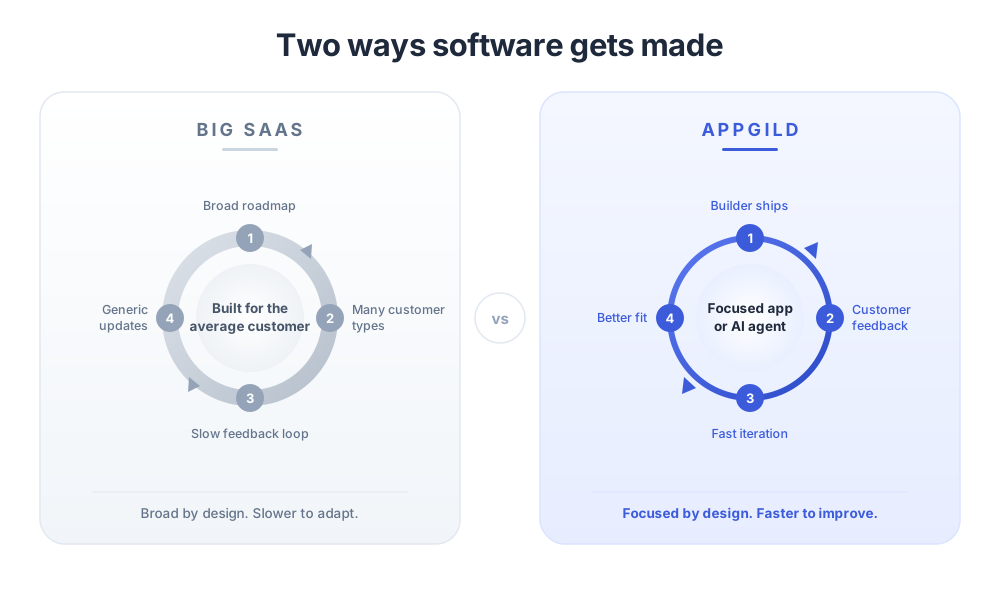
Here’s the part worth being precise about, because it’s where the hype usually goes wrong. This is not about out-engineering engineers. You won’t, and you don’t need to. The advantage is fit and speed. A big SaaS company builds for the average of ten thousand customers and ships on a quarterly roadmap. Someone who works inside a bookkeeping firm, a dental front office, or an HVAC dispatch room, or who is one degree away from someone who does, knows which single step of the workflow hurts most. And when that workflow changes (a new tax form, a new platform policy), a solo builder can adapt in days.
That’s the asymmetry: not better engineering, better aim and a faster loop. The build still has to be competent. You still have to test it, fix it, and stand behind it. But the thing that was hard for you (writing the code) got easy, and the thing that’s hard for the big platforms (knowing your niche and turning on a dime) never got easier for them.
Build an agent that does the work, not just the math
The first wave of focused tools answers questions: what should I charge, what’s my margin, what goes in this packet. The next wave acts. An agent is software that does a task for you (drafts the proposal, chases the missing document, reconciles the numbers, answers the customer at 2am) rather than giving you screens to do it in.
That matters in two plain ways. People pay more for work done than for a calculator: an agent that saves a bookkeeper six hours a month is worth far more than a tool that saves six minutes, and it earns its keep every month. And the judgment you’d normally sell by the hour becomes something you can package once and sell many times.
The bar is higher, and that’s the point. A good agent is honest about what it can and can’t do, tells the buyer which model it runs on and what it touches, and keeps the person in control of anything that matters. AppGild gives every agent listing a clear place to say all of that. If you can describe the work, you can build an agent that does a piece of it. Build the one only you could.
Who this is actually for
Two requirements. You need a real claim on both.
You can ship. With AI tools or with code, you can take a focused piece of software from idea to working product, test it honestly, and fix it when it breaks. You finish what you start. The discipline of putting your work in front of strangers, hearing what’s wrong with it, and adjusting without ego: that’s the part the AI tools can’t do for you.
You’re close to a specific kind of work. Your own job, a past career, or one degree away: a spouse’s bookkeeping firm, a friend’s HVAC company, the dental office your sister manages. Proximity is what tells you which painful step is worth solving. Proximity without the ability to ship is a wish. Shipping without proximity is a guess.
You don’t have to be equally strong on both today. Most builders who succeed here are stronger on one side and willing to do the other side anyway. AppGild’s Build Assistant helps you scope the simplest version that could possibly work.
This is not the right place for you if you’re hoping AI tooling alone will carry you to passive income. The tooling makes the build dramatically easier. Picking the right narrow problem, finding the first real customers, and listening when they tell you what’s wrong still takes work. There’s no version of this where you skip that part and it still works.
Here’s how the wiring you already have maps to this work
The most valuable thing you bring to building software is not technical. It’s the specificity of having lived inside one kind of work. A few examples of what that looks like:
You freelance. You’ve built the same Shopify store, written the same blog post, run the same revision loop fifty times. If you’ve filled out the same onboarding questionnaire for the fiftieth time, you are staring directly at a product opportunity. Build the thing you’re tired of doing manually. Sell it to the people who’d be tired of it too.
You’re a bookkeeper, ProAdvisor, or tax preparer. You see the inside of more businesses in a year than most people see in a lifetime, and you watch the same five mistakes repeat across thirty clients. That repeated pattern is the product. The clients who pay you to clean it up will pay a tool to prevent it.
You’re a real estate agent or property manager. Open the spreadsheet you’ve been rebuilding for years: the lead tracker, the CMA template, the turn checklist. That spreadsheet is the prototype, and ten thousand agents in your market would pay monthly not to build it themselves.
You run a medical, dental, or vet front office. The clinical side has hard compliance lines, and patient data runs through the admin side too; respect both. But the administrative workflows you live in every day are home to some of the worst software in the economy. Build the version of your daily tool that doesn’t make you want to quit.
You teach, tutor, or train clients. You can predict the exact step where the learner or client gets stuck, because you’ve watched it a hundred times. A focused tool for that one wall, built once, earns while you teach the next class.
The pattern across all five is the same: specificity. You’ve lived inside one specific kind of work and sold something to one specific kind of person. Software founders pay consultants thousands of dollars a day for the insight you have for free. That asymmetry is new, and right now it’s wide open.
The honest version of what this takes
Anyone who tells you this is easy is selling you something. Probably a course.
The build is no longer the bottleneck: typically a few weekends of focused effort. Aim for the version that solves 90% of the pain with 10% of the complexity. A focused workflow tool is enough. That’s where you should start.
The hard part comes after. Nobody knows your app exists, so you have to tell them: find the people in your industry, in the Facebook group, the subreddit, the trade pub comments, and talk about the problem in the language they actually use. Follow up when they don’t reply. Do it for weeks before anything shifts. This is where most people quit. Not the building. The talking.
If nobody buys your first attempt, that’s not a verdict on you. It’s market feedback, and clear rejection is more useful than vague optimism. The builders who get traction are rarely the ones who guessed right on day one. They’re the ones who stayed close enough to the problem to adjust without ego.
And if you stay with it, somewhere a few months in, something flips. Customers start finding you. Search traffic arrives. The first sign-up you didn’t chase lands in your inbox, and the gravity reverses: you’re not pushing anymore, they’re pulling. That’s compounding. That’s the moment February’s work starts paying you in May.
By the end of a year you’re a different kind of worker. You know how to find a niche pain, build for it, and grow it. The second app is dramatically faster than the first. That skill is your insurance policy against a volatile future.
What it looks like when it starts to work
We’re not going to promise you a number. When we have real data from real builders, we’ll publish it. Until then, the milestones that tell you you’re on the right path:
- One paying stranger. Not your friend, not your mom. Someone who found your app and decided it was worth their money. First proof your insight has market value.
- Five users giving similar feedback. When five separate people name the same gap, you’ve found your next feature.
- Ten users who’d notice if it broke. People depend on it. You’re past the novelty phase.
- One inbound customer. Someone found you without being asked. The flywheel is spinning on its own.
- The second app is easier than the first. The build is faster, the outreach converts better, the loop is tighter. You’ve become the operator.
None of these require luck. All of them require showing up consistently.
Why AppGild
We’re not a storefront. A storefront would take your money and list your thing.
Underneath the marketplace we build the things that compound your work: feedback capture so you hear what customers want, AI tools so you know which feedback matters, a builder community that reviews your work, and SignalSeed, our prospecting tool, so outreach is less soul-crushing. Your customers decide which apps are good, through their reviews and whether they keep paying. Our job is to give you the tools to be one they keep.
Listing is free. If you grow, we grow.
One technical limit worth knowing up front: builder payouts run through Stripe Connect, and not every country is supported. During signup you’ll see whether payouts are available in your country before you invest time building.
Etsy turned craftspeople into a global retail category. Shopify did it for small merchants. Decades earlier, catalog companies proved that products move through trusted relationships. The pattern is a platform plus a newly cheap capability creating a category of livelihood that didn’t exist at scale. Focused software, built by the people who actually know the niches, is next.
Start this week
You’ve read this far. You’re not going to consider it harder by reading another article.
Pick a problem you’ve personally felt at work. The kind where you’ve thought “I’d pay forty bucks a month to make this go away.”
Sign up at appgild.ai. Use the Build Assistant to describe the problem and get a build spec for the simplest version that works.
Build it. Lovable, Bolt, Cursor, or Claude Code. Pick whatever feels least intimidating.
List it on AppGild. The submission flow takes thirty minutes.
Then do the hard part. For the first three months, spend a few hours a week telling people in your industry this exists. We’ll give you outreach templates, a community figuring it out alongside you, and SignalSeed to find prospects. This stretch is where most people fold. Don’t fold.
The compounding starts the day you publish, not the day you decide to publish. The best week to start is this week. The second-best week is the week after, but you and I both know how that one usually goes.
When you hit that post-launch stretch, there’s a longer guide on the blog: how builders find their first customers after launch, one at a time, without an ad budget.